
Maka Marketing Team
Jul 28, 2026
What's Actually Worth Watching: Recapping Our Conversation with a Children's Media Researcher
One thing that comes up time and again when we talk with parents is: “how can I tell if a show is actually good for my kid?”
Not just safe, but genuinely good. Engaging enough to hold their attention while still produced in such a way that bedtime doesn’t become a meltdown. Thoughtfully made, in a way that also makes sense developmentally.
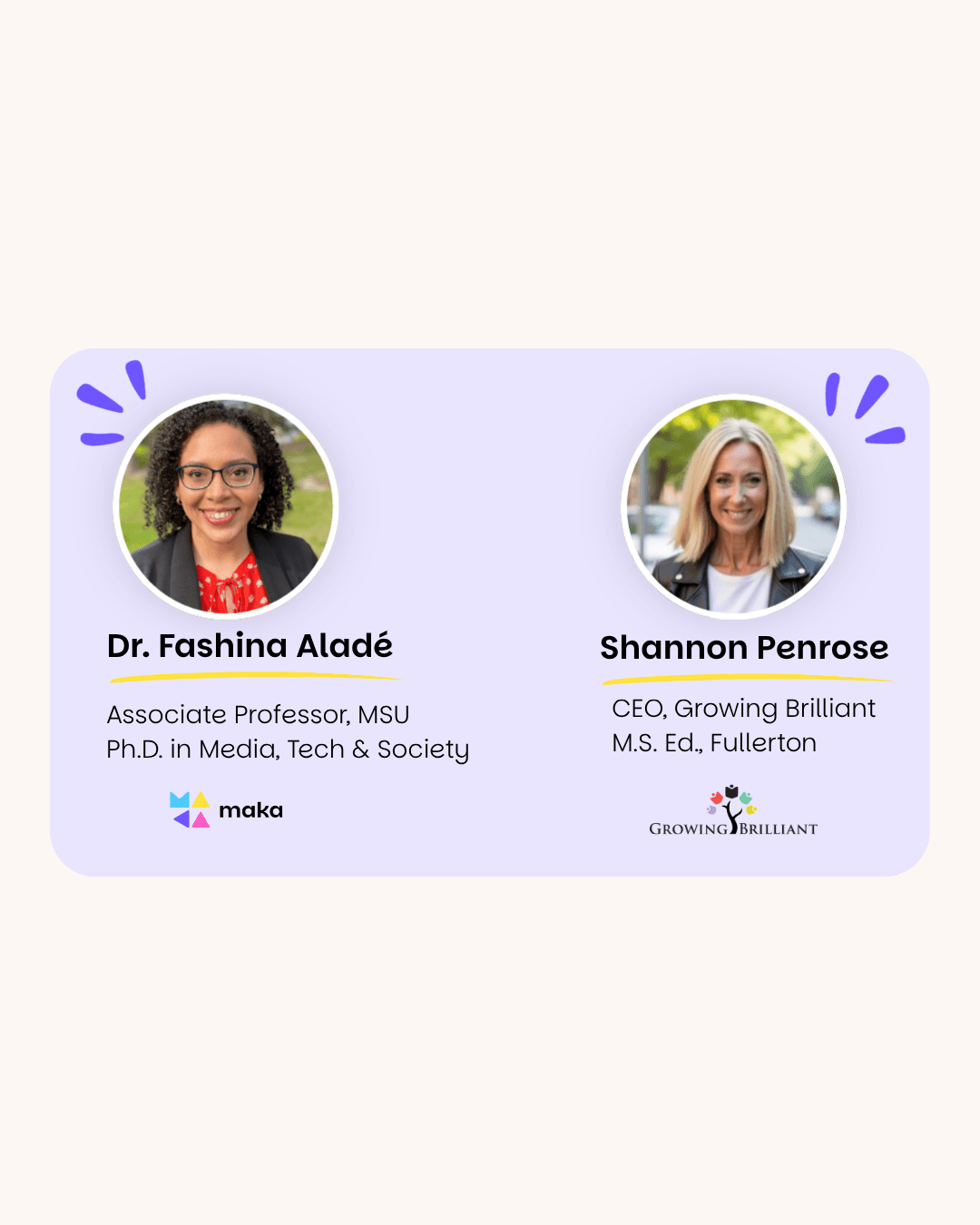
We partnered with Growing Brilliant, a live online preschool for children ages 2-6, to dive deeper into what the research actually says about quality children’s media. Dr. Fashina Aladé, Chief Research Officer in Residence at Maka and an Associate Professor at Michigan State University, led the conversation around how to identify shows that genuinely support your child’s development, and why it’s not as complicated as it sometimes feels.
In this post, we’re sharing the core insights from the talk, plus answers to the questions parents asked that hint at the real anxieties most of us are sitting with.
What Actually Makes a Show “Educational”?
The word “educational” gets thrown around so much that it’s become nearly meaningless. Parents open the App Store, see thousands of options labeled “educational,” and have no idea which ones are actually worth their child’s time.
Dr. Aladé broke it down: a truly educational show is one designed with a curriculum or learning framework built in from the beginning—not an afterthought. The story, the characters, and the lesson all move together. When a character uses math or literacy to solve a problem in their adventure, that’s when real learning sticks. When the alphabet or counting is tacked on as a separate segment, it’s not as valuable.
But here’s something that surprised us on the call: not everything that’s high-quality needs to be educational. A beautifully paced show that models kindness or helps a child feel less alone can be equally valuable. The through-line isn’t whether it’s teaching academics; it’s whether the show is designed with a child’s whole development in mind, and delivered in a way that doesn’t overstimulate that particular child.
The Biggest Misconception Parents Are Living With
Dr. Aladé brought up a misconception she hears all the time: the belief that all screen time is bad. Think about how much weight this carries for you as a parent. You hear it everywhere: “Screen time is evil.” AAP says to limit it. Instagram Reels decry it. So you feel guilty when you need 20 minutes to make dinner. You feel like you’re failing at something that shouldn't be that controversial. We all grew up watching TV, right?
But here’s what the actual research suggests: quality matters. Your mental health as a parent matters more. Being a healthy, present parent is worth far more than screen time limits. And high-quality shows can actually support your child’s development, not just avoid harming them.
That reframe means you’re not fighting screens as an enemy. You’re choosing them thoughtfully when they make sense for your family.
How to Tell If Your Child Is Engaged or Overstimulated
Parents often describe their child looking “entranced” during screen time and worry it means their brain is overstimulated. Dr. Aladé gently pushed back on this. When a young child is deeply focused on a screen, they’re doing a lot of mental work to process what they’re seeing. Just like a kid absorbed in a book might look “zoned out,” when they're actually learning and growing right in front of your eyes.
The more useful signal? Assess their behavior afterward, not their face. If a certain show (we know which ones they are in our households!) often results in a meltdown when it's time to move on to the next activity, that's useful evidence for you as a parent.
While every child is different, fast-paced, flashy, loud content can be overstimulating for some. Slow-paced content with natural breathing room tends to indicate higher quality content.
What Parents Asked
"What is the best way to handle younger children watching older sibling shows?" Co-viewing across ages isn't inherently a problem. The concern is only if screen time consistently displaces other developmentally important activities. A younger child picking up some incidental viewing while an older sibling watches isn't harmful in itself — the relationship and home environment matter far more.
Practically speaking, if the older child is watching something for the younger child that is well-designed, they'll usually still watch it, even if they complain a bit. The realistic advice: focus on harm reduction. Make sure what your older kid is watching isn't modeling behaviors you don't want either child to see. If the educational content is a little over the head of your younger child, that's okay. Ideally, they can take turns watching shows designed for their respective age ranges.
What works best is shows that appeal to a wide range of audiences — which is where story-driven, narrative-focused content has an advantage. Great stories tend to be appropriate for wider age ranges, rather than a particular educational lesson designed specifically for one age group. To the extent possible, aim for some turn-taking so each child gets a chance to watch things appropriate for them.
"How long before bedtime should screens be turned off?" Unfortunately, there is no hard and fast rule. This comes down to the individual child. The encouragement is to experiment a little bit. Try a week where you're making sure screen time ends an hour before bedtime and see how that goes. Then depending on what's doable for your life, try another week with a little bit more or a little bit less, and see what works for your child.The good news is there's no "it must be this certain thing." Some of us are more susceptible to blue light effects than others. If you aren't noticing negative effects, it's probably okay.
Keep in mind that screens are just one piece of the whole parenting and child development puzzle. While you want to give your kids rich, high-quality digital experiences, what matters most is the caregiver-child relationship and all the other inputs you're giving them.
What Comes Next
Maka is built for exactly these questions. We source beautiful stories from around the world. Every episode is evaluated for pacing and against our developmental framework created with researchers at Yale Child Study Center.
Parents can trust that the shows their children love are also supporting their development.
References
Guernsey, L. (2007). Into the minds of babes: How screen time affects children from birth to age five. Basic Books.