
Expert-reviewed by Dr. Kristyn VanDahm
Dec 20, 2025
Screen Time and the Holidays: What Child Development Research Actually Says
During this time of year, filled with travel and traditions, families find themselves navigating airports, traffic, unfamiliar beds, and very big feelings from very small people.
Almost inevitably, screen time enters the picture. But if togetherness is supposed to be the point of this season, screens can feel like a contradiction. But developmental research offers a steadier way to think about this. Togetherness isn’t defined by the absence of screens. It is shaped by everyday moments with family that develop emotional security, resilience, and connection for life.
What actually builds connection for young children
Kids develop emotional security through repeated, everyday interactions with caregivers who are responsive and emotionally available. These interactions needn't be elaborate, they just need to be consistent, warm, and responsive enough to create a pattern for your kid.
These little connection moments become even more important during the holidays, when new environments, overstimulation, and unpredictability can overwhelm developing regulatory systems. When that happens, young children rely on adults to help them settle and make sense of what is happening.
This process is often described as co-regulation. Adults regulate young children when they are not yet capable of doing it for themselves. Through many shared moments of calming, labeling feelings, and moving through stress together, children gradually build the ability to regulate themselves.
These moments rarely look polished. They happen while buckling car seats, waiting in security lines, walking long corridors, and settling into unfamiliar spaces. They can also happen while watching screens.
Screen time is not one experience
Research on screen time and child development is often flattened into simple conclusions. In reality, screen time is not a single experience. Content matters. Pacing matters. Context matters.
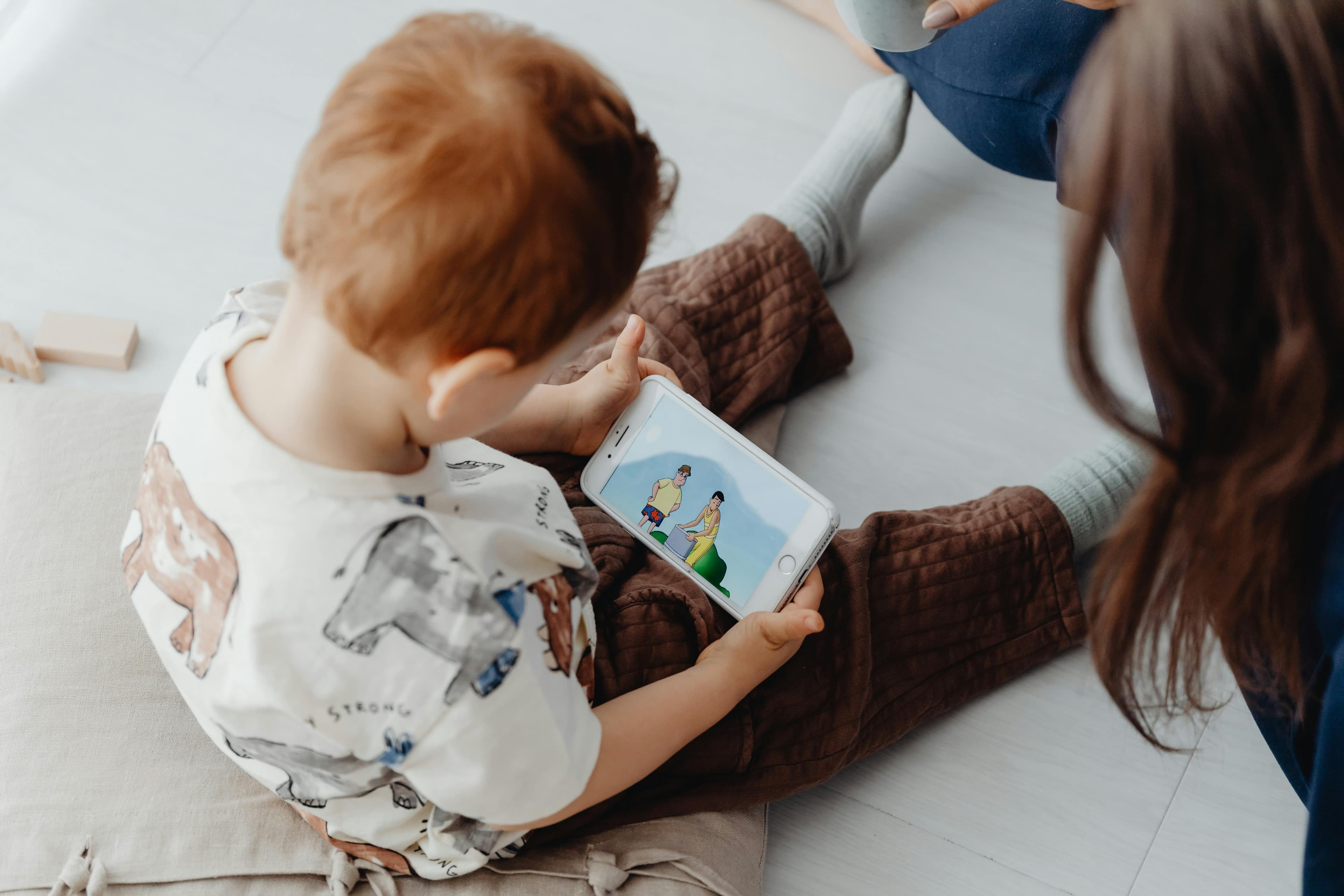
Togetherness doesn’t stop when a screen turns on. In fact, research shows that co-viewing (watching the same shows and engaging together) can actively support learning, empathy, and emotional development. So each episode can be an opportunity for connection.
This does not mean screens teach these skills on their own. Videos can offer prompts, language, and shared reference points. Family togetherness can look very different across cultures, households, and stages of childhood. What matters is not uniformity, but the presence of warm, responsive relationships.
What co-viewing can look like in everyday moments
Co-viewing doesn’t mean turning screen time into an academic lesson by asking constant questions. Often, the most developmentally supportive moments are brief, natural, and woven into what you’re already doing.
Research on early relationships points to the value of small, repeatable interactions that help children link what they see on screen to the people and relationships that matter most in their real lives.
- Infants: After a video, hold your baby close and name the people who love them. “We just watched families being together. In our family, you have me and Daddy.”
- Toddlers: After an episode ends, ask: “Who was together in that story?” or “Who do you like to be with?” Their answers might include you, siblings, neighbors, or stuffies.
- Preschoolers: When a show ends, ask for one word about how the family on screen felt together, and one word about how your own family felt that day, creating space for emotional awareness.
Across ages, what matters isn’t saying the “right” thing. It is signaling shared attention. These moments work because they help children experience screen time as something that happens inside a relationship, not apart from it.
Why this matters
Development doesn’t hinge on any single moment or activity. Kids build emotional security through repeated experiences of being noticed, responded to, and guided by caregivers over time. Small, relational moments around screen time can support that process, especially during busy or transitional days.

Reframing the screen time guilt
Lots of parental anxiety around screen time comes from the feeling that every decision carries long-term consequences. Luckily, developmental science points to a more forgiving reality.
Kids don’t develop through isolated moments. They develop through patterns. Some screen time during a long travel day does not shape attachment or emotional health. What matters is the broader pattern of responsiveness, connection, and repair over time.
This framework leaves room for real family life. Parents are balancing logistics, exhaustion, and competing demands. Screen time can provide a little practical support in those moments. Used thoughtfully, it can reduce stress without eroding connection.
The takeaway
Children grow through relationships first and foremost. Daily interactions shape how they understand themselves and the world around them. The most powerful developmental inputs are often quiet ones: being noticed, being guided through change, just being with your child when things feel hard for them.
When kids experience us helping their “big” feelings feel “small,” they learn they don’t have to face challenges alone. Over time, these shared moments help kids learn how to deal with big feelings on their own?. Even more importantly, they strengthen the bond between parents and their children.
So remember: Relationships are the foundation. Everything else is a tool.
How to connect: Holiday-inspired tips
- Infants: It’s never too early to start connecting over the holidays. All those cards in the mail? Put ‘em to use with a “Faces We Love” holiday wall.
- Put up photos of important people at baby’s eye level (fridge, hallway)
- Once a day, walk over, point, and say, “This is ___, who loves you from far away. This is ___, who makes you laugh.”
- Toddlers: Go on a “lights walk.” When you pass lights or decorations, repeat the line “Different houses, different ways of celebrating, but all with people they love.”
- Preschool: Start involving your children more deeply by inviting them to help build a “Family December Playlist.” Remind them: “Every time one of these plays, it’s a reminder that we’re on the same team.”
References
Ainsworth, M. D. S. (1989). Attachments beyond infancy. American Psychologist, 44, 709 –716. http://dx.doi.org/10.1037/0003-066X.44.4.709
Archer, K., Wood, E., & De Pasquale, D. (2021). Examining joint parent-child interactions involving infants and toddlers when introducing mobile technology. Infant Behavior and Development, 63, 101568
Gillespie, L. (2015). It takes two: The role of co-regulation in building self-regulation skills. YC Young Children, 70(3), 94-96.
Marvin, R., Cooper, G., Hoffman, K., & Powell, B. (2002). The Circle of Security project: Attachment-based intervention with caregiver-pre-school child dyads. Attachment & human development, 4(1), 107-124.
Murray, D. W., Rosanbalm, K., Christopoulos, C. & Hamoudi, A. (2014). Self-Regulation and Toxic Stress: Foundations for Understanding SelfRegulation from an Applied Developmental Perspective. OPRE Report #2015-21, Washington, DC: Office of Planning, Research and Evaluation, Administration for Children and Families, U.S.Department of Health and Human Services.
Rasmussen, E. E., Shafer, A., Colwell, M. J., White, S., Punyanunt-Carter, N., Densley, R. L., & Wright, H. (2016). Relation between active mediation, exposure to Daniel Tiger’s Neighborhood, and US preschoolers’ social and emotional development. Journal of Children and Media, 10(4), 443-461.
Strouse, G. A., O'Doherty, K., & Troseth, G. L. (2013). Effective coviewing: Preschoolers’ learning from video after a dialogic questioning intervention. Developmental psychology, 49(12), 2368.